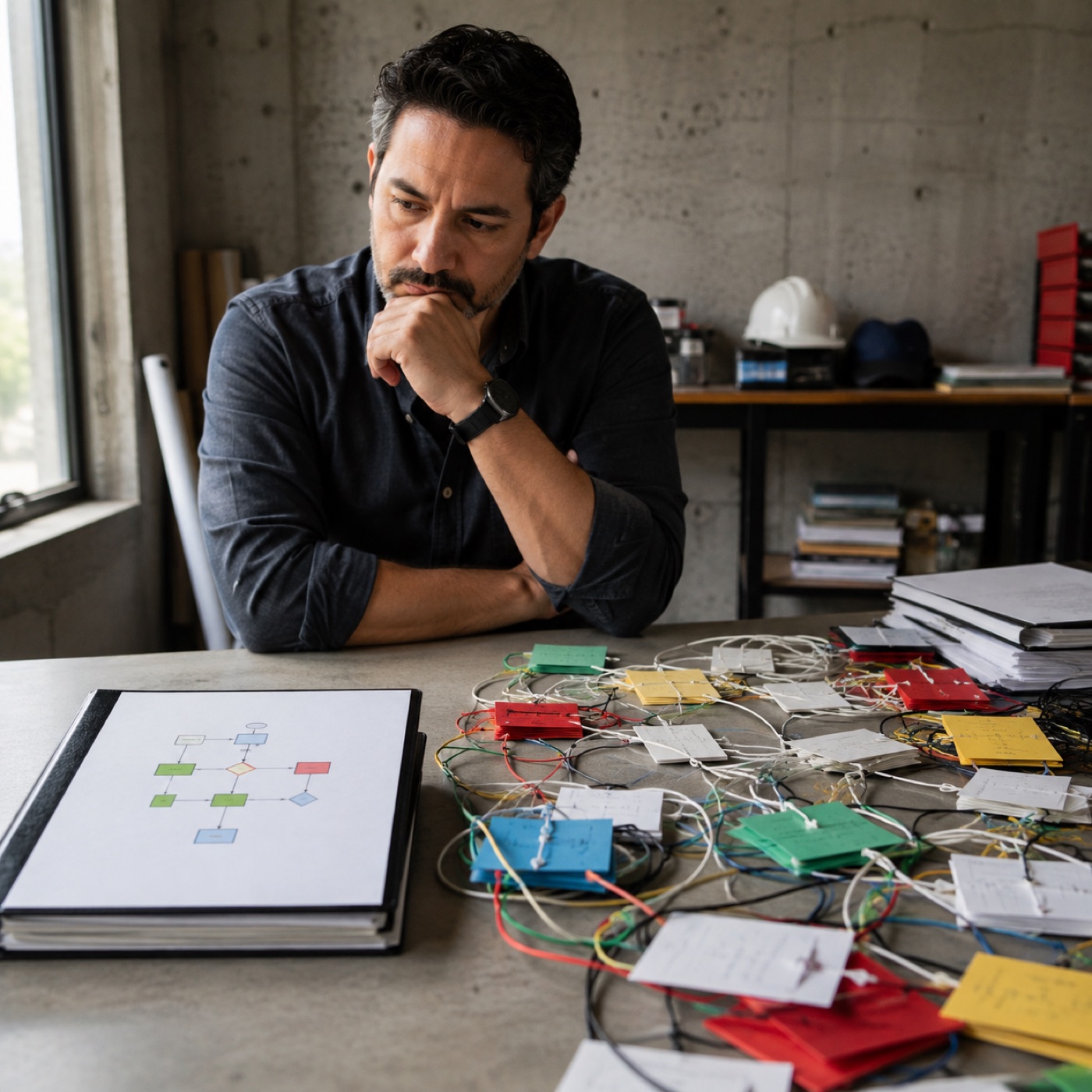
When a process is broken, the usual reaction is to ask for documentation. It sounds responsible, but it often produces a cleaner description of the same disorder.
Documentation records what we already understand. If no one can explain why a step exists, who makes a decision or what information that person needs, writing a manual will not solve the problem. It will make the problem harder to question.
A document cannot replace understanding
A process is not a sequence of boxes and arrows. It is a way to coordinate people, information, decisions and results. The visible sequence may look correct and still fail because context arrives late, accountability is ambiguous or every team has a different definition of done.
Before opening a template or drawing a flow, answer four questions:
- Why does this step actually exist?
- Who needs the information it produces?
- Where is context lost or work repeated?
- Which decision, risk or outcome is it meant to control?
These questions change the conversation. The goal is no longer to record habits, but to identify which parts of the work create value and which exist because the system has never been challenged.
What useful documentation should preserve
Good documentation does not try to capture every movement. It preserves what helps people act: the purpose of the process, its inputs and outputs, relevant decisions, owners, exceptions and evidence that the outcome was achieved.
It also makes dependencies visible. If someone must request information through chat every time a task is performed, that chat is not an invisible part of the process. It is evidence that information is not where it needs to be.
The level of detail should match the risk. A critical procedure may require controls, traceability and explicit criteria. A simple task may need only a short checklist and an example. Documenting everything at the same depth creates volume, not clarity.
Process first, document second
The practical order is to observe the work, understand the expected outcome, remove purposeless steps, clarify decisions and accountability, and only then document the version worth repeating.
Documentation should live close to the work and change when the process changes. Separated from operations, it becomes a historical snapshot that no one reads. Embedded in the flow, it helps onboard people, review controls and detect deviations.
Documentation matters. It works as the conclusion of a design conversation, not as a substitute for one.